Air Purifier Review: Features, Benefits & Buying Guide
Indoor air quality is an important consideration for homeowners, renters, families, and pet owners across the United States. Dust, pollen, smoke particles, cooking activities, and other everyday sources can contribute to indoor air pollution.
An air purifier may help reduce certain airborne pollutants when the device has suitable filtration technology and enough airflow for the room where it operates.
But is the air purifier featured on our website the right choice for your home?
In this review, we explain how air purifiers work, which features matter most, what to check before purchasing, and how to determine whether a particular model offers good value.
If you are considering an air purifier for your bedroom, living room, home office, or another indoor space, this guide will help you make a more informed decision.
What Is an Air Purifier?
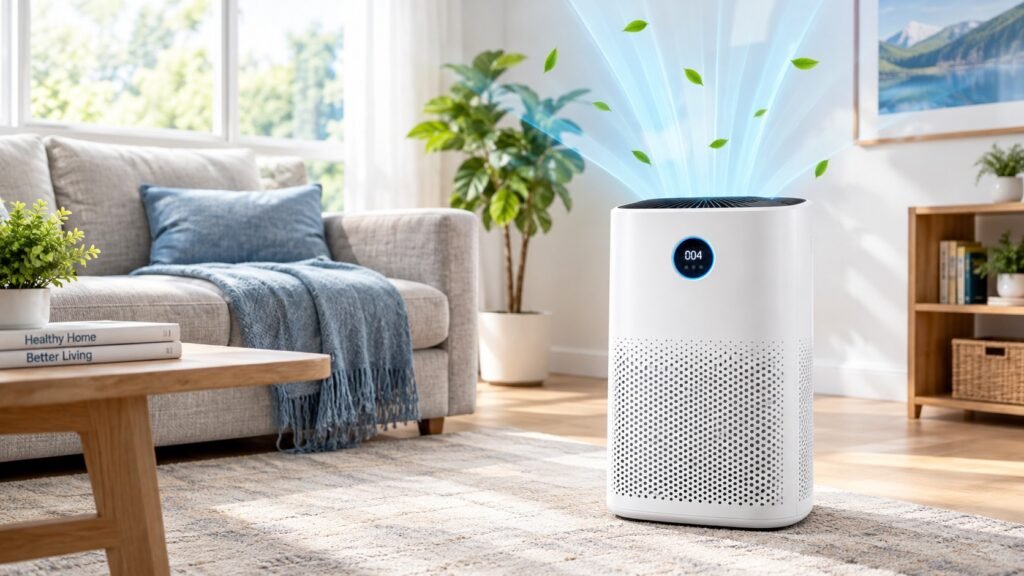
An air purifier is an electrical device designed to circulate indoor air through a filtration or purification system. Depending on its technology, it can help capture airborne particles or reduce certain gases and odors. Portable air purifiers are generally intended for individual rooms or defined areas rather than automatically cleaning an entire house.
Common indoor airborne pollutants include:
- Dust and other suspended particles
- Pollen from outdoor sources
- Pet dander
- Smoke particles
- Certain particles generated during cooking and cleaning
Different filtration technologies address different pollutants. For example, a suitable particle filter can capture airborne particles, while activated carbon may help reduce certain gases and odors. According to the US Environmental Protection Agency (EPA), filtration can complement source control and ventilation, but no air cleaner removes every indoor pollutant. For more information, see the EPA’s guide to air cleaners and air filters in the home.
Air Purifier Review: Features to Evaluate
Before deciding whether to purchase this air purifier, check the manufacturer’s specifications and determine which features are included in the actual model being offered.
1. Filtration Technology
The filtration system is one of the most important factors to consider. A HEPA filter is designed to capture airborne particles, while a pre-filter may collect larger particles before air reaches the main filter. Some models also include activated carbon to help reduce certain odors and gases.
However, not every air purifier includes all these components. Before purchasing, verify the exact filter type, filtration claims, and replacement-filter availability.
2. Room Coverage and Airflow
An air purifier should be appropriately sized for the room in which you intend to use it. Check the manufacturer’s recommended room area and Clean Air Delivery Rate (CADR), where available. CADR indicates how quickly an air cleaner delivers filtered air for specified particle types.
A unit designed for a small bedroom may not provide sufficient airflow for a large, open living area. To estimate room size, multiply its length by its width. For example, a room measuring 15 feet by 20 feet has an area of 300 square feet. Compare that measurement with the product’s published performance information before buying.
3. Noise Levels and Operating Modes
Noise can be an important consideration if you plan to operate an air purifier in a bedroom, nursery, or home office. Look for published decibel ratings at different fan speeds. A lower fan speed may be quieter, although it generally filters less air than a higher setting.
If the product advertises sleep mode, automatic operation, or adjustable fan speeds, confirm that these features are included in the model you are purchasing.
4. Filter Replacement and Maintenance
Air purifiers require maintenance to maintain their intended performance.
Before ordering, investigate:
-
How frequently the filters should be replaced
-
Whether replacement filters are readily available
-
The price of replacement filters
-
Whether the unit has a filter replacement indicator
-
How the exterior and pre-filter should be cleaned
A lower purchase price does not necessarily mean lower long-term costs. Filter replacements and electricity usage can affect the overall cost of ownership.
5. Energy Consumption
If you plan to operate an air purifier for several hours daily, energy consumption is worth considering. Check the device’s rated power consumption and estimate how much electricity it may use at your expected operating schedule. Actual consumption depends on the unit, selected fan speed, and operating time.
Potential Benefits of Using an Air Purifier at Home
An appropriately selected air purifier can provide several practical benefits, depending on its design and the indoor environment.
Helps Reduce Certain Airborne Particles
Air purifiers with suitable particle filtration can capture airborne dust and other particles. This may complement normal household cleaning, although filtration does not remove dust that has already settled on floors or furniture.
May Help Capture Airborne Pollen
For households concerned about pollen, a properly sized purifier with suitable particle filtration may help reduce pollen circulating indoors. Keep windows and doors, outdoor pollen conditions, and other sources in mind when evaluating indoor air quality.
Can Be Useful in Homes With Pets
Pet owners may consider an air purifier to help capture airborne pet dander and particles. However, a purifier cannot eliminate every pet allergen. Regular cleaning, vacuuming, and washing suitable fabrics remain important.
May Help Reduce Certain Odors
Some air purifiers include activated carbon or another gas-adsorption filter. These systems may help reduce certain odors, depending on the filter’s design and capacity. Ordinary particle filters alone generally do not remove gases effectively.
Offers an Additional Indoor Air Quality Measure
An air purifier can be one part of an indoor air quality strategy. Reducing pollution sources, maintaining ventilation when outdoor conditions permit, and following appropriate maintenance practices are also important. No air purifier should be assumed to eliminate every contaminant or prevent illness.
How Does an Air Purifier Work?
Most portable air purifiers use a fan to draw room air through a filtration system before releasing the filtered air back into the room.
The general process works as follows.
Step 1: Air intake
The fan draws indoor air into the device.
Step 2: Filtration
Air passes through one or more filters that capture particles or target other pollutants, depending on the technology.
Step 3: Additional treatment, if included
Some models use activated carbon or other technologies to address selected odors or gases. The effectiveness depends on the system’s design.
Step 4: Air circulation
Filtered air returns to the room. The unit continues circulating air while operating.
Actual performance depends on airflow, filter condition, room size, placement, and operating time.
Who Should Consider Buying an Air Purifier?
An air purifier may be worth considering if you want to address specific indoor air quality concerns.
Homeowners and Renters
People who spend considerable time indoors may want to evaluate air filtration as one part of their home environment.
Pet Owners
A suitable particle filter may help reduce airborne pet dander in rooms where animals spend time.
People Concerned About Dust and Pollen
A purifier with appropriate particle filtration may help capture airborne dust and pollen.
People Living in Areas Affected by Smoke
During periods of wildfire smoke or other particle pollution, an appropriately selected portable air cleaner may help reduce indoor particle levels.
Follow local public health advice and choose equipment with performance appropriate for the space.
Bedroom and Home Office Users
A suitably sized model with an acceptable noise level may be useful in rooms where people sleep, work, or relax.
The right choice depends on your needs, room dimensions, budget, and the verified capabilities of the product.